
 Portugues
 Pусский
pulley
The Function and Applications of Pulleys A pulley is a simple machine consisting of a wheel with a grooved rim and a rope or cable that runs along the groove. It is designed to change the direction of an applied force, making it easier to lift or move heavy loads. Pulleys are fundamental components in various mechanical systems, offering mechanical advantage by distributing weight and reducing the effort required to perform tasks. Types of Pulleys There are three main types of pulleys: 1. Fixed Pulley – The wheel is attached to a stationary structure, such as a ceiling or beam. It changes the direction of the force but does not provide a mechanical advantage. For example, pulling downward on a rope to lift a bucket upward. 2. Movable Pulley – The wheel is attached to the load, reducing the effort needed to lift it. This type provides a mechanical advantage, as the force required is only half the weight of the object (assuming an ideal, frictionless system). 3. Compound Pulley (Block and Tackle) – A combination of fixed and movable pulleys increases the mechanical advantage further, allowing heavy objects to be lifted with minimal effort. This system is commonly used in cranes, elevators, and sailing rigs. Applications of Pulleys Pulleys are widely used in various industries and everyday life: - Construction and Engineering – Cranes and hoists rely on pulley systems to lift heavy materials like steel beams and concrete blocks. - Transportation – Elevators use pulleys to move cabins smoothly between floors. - Fitness Equipment – Weight machines incorporate pulleys to guide cables and adjust resistance. - Maritime Use – Sailboats utilize pulleys (blocks) to control sails and rigging efficiently. - Household Applications – Clotheslines, window blinds, and garage doors often incorporate pulley mechanisms for ease of use. Advantages of Pulleys - Reduced Effort – By distributing weight, pulleys make lifting heavy objects easier. - Direction Change – They allow force to be applied in a more convenient direction (e.g., pulling down instead of lifting up). - Versatility – Different pulley configurations can be adapted for various tasks. Despite their simplicity, pulleys play a crucial role in modern machinery and daily life, demonstrating how basic physics principles can enhance efficiency and productivity.
Products
Category:
-
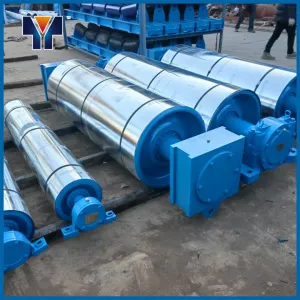
roller
Category: RollerBrowse number: 2Number:Release time: 2025-09-19 10:14:00The drum is a core cylindrical component in equipment such as conveyors, printing, and mining, usually made of metal (such as carbon steel, stainless steel) or non-metallic materials, and achieves material conveying, guiding, or power transmission functions through rotational motion. -
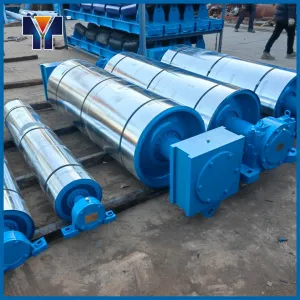
delivery cylinder
Category: RollerBrowse number: 3Number:Release time: 2026-01-05 14:39:18The conveyor drum is the power core and transmission key component of a belt conveyor. Its main function is to transmit power, support the conveyor belt, change the direction of the conveyor belt, and directly determine the operating efficiency and stability of the conveyor. It is widely suitable for light and heavy conveyor systems in industries such as mining, coal, metallurgy, grain, and building materials.Core Categories and FunctionsDrive drumAs the power output component of the conveyor, it is connected to power devices such as motors and reducers, and drives the entire conveyor belt to...
News
Category:
-
[Conveyor Roller]Heavy-duty conveyor rollers for mining
2025-09-19 10:59:23
Case
Category:

Video
Category:
No search results found!
Download
Category:
No search results found!
Job
Category:
No search results found!
Featured Products
-
NEWS
roller
Learn more -
NEWS
delivery cylinder
Learn more



 Phone
Phone