
 Portugues
 Pусский
pivot beam
The Pivot Beam: A Conceptual Exploration of a Fundamental Structural ElementThe term "pivot beam, while not a standardized technical term in classical structural engineering, evokes a powerful and versatile concept. It describes a structural member—a beam—whose primary function is not merely to support load through simple bending, but to serve as a deliberate and strategic axis of rotation or a transitional element within a larger system. It is a beam that embodies the principle of controlled movement or decisive redirection of forces.At its core, a beam is a horizontal element designed to resist loads applied laterally to its axis, primarily through internal bending moments. A pivot beam takes this fundamental role and adds the critical dimension of pivoting. This implies a specific point or zone along the beam's length that is designed to allow rotation. This pivot point could be a physical connection, like a large-diameter pin, a specialized bearing, or a carefully detailed moment connection that allows limited rotation. The beam itself may remain rigid, but its connection to the wider structure facilitates movement.The applications of such a concept are manifold. In dynamic structures, a pivot beam is essential. Consider a drawbridge: the main span acts as a massive pivot beam, rotating upward on a central or rear trunnion. The beam's strength carries the road deck, but its engineered pivot transforms it from a static span into a moving gateway. Similarly, in heavy machinery like cranes or excavators, the boom often functions as a pivot beam. It supports immense loads at its tip, but its value is unlocked by its ability to rotate at the base, sweeping through arcs to place loads precisely. The beam transmits force, but the pivot enables range.In architectural and structural design, the pivot beam concept appears in systems that require flexibility or transformative spaces. Large movable partitions or theater fly systems utilize beams that pivot to raise, lower, or reconfigure elements. More subtly, in seismic design, certain beams in a moment-resisting frame are designed to form "plastic hinges"—controlled yielding zones that act as sacrificial pivots. These beams absorb catastrophic energy by rotating at these designated points, preventing total structural collapse. Here, the pivot is not for daily movement but for ultimate, life-saving deformation.The engineering considerations for a pivot beam are profoundly complex. First, the pivot connection itself is paramount. It must allow the required rotation while transferring tremendous shear forces and possibly axial loads. Friction, wear, lubrication, and material fatigue become critical design factors. Second, the beam's behavior changes. As it rotates, the load paths and the nature of the stresses (bending, torsion, combined stresses) can shift dynamically. The beam must be designed for its entire range of motion, not just a static position. Third, stability is crucial. A beam that pivots, especially under load, risks buckling or inducing unwanted oscillations. Careful analysis of its behavior in all configurations is essential.Furthermore, the concept extends into the metaphorical realm of system design. A "pivot beam" can describe a critical transitional element in a process or network—a component that receives input from one direction and, by "pivoting," redirects energy, information, or resources efficiently to another. It is the linchpin that allows for reorientation and adaptability.In conclusion, the pivot beam is more than a simple support; it is an enabler of motion and transformation. It represents the fusion of static strength with dynamic function. Whether in the grand rotation of a bridge, the precise arc of a crane, the yielding joint of an earthquake-resistant building, or even as a conceptual model for adaptive systems, the pivot beam stands as a testament to engineering ingenuity. It is the element that understands that true strength often lies not in rigid resistance, but in controlled, purposeful movement.
Products
Category:
-
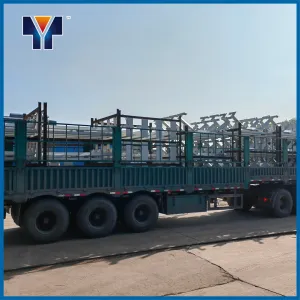
crossgirder
Category: BeamBrowse number: 4Number:Release time: 2026-01-05 16:17:51The conveyor crossbeam is the core load-bearing component of the belt conveyor frame system, mainly used to connect the columns on both sides of the conveyor, bear the weight of the roller group, conveyor belt, and conveyed materials, and provide installation reference for auxiliary components such as rollers and cleaners. It is the "backbone skeleton" that ensures the stable operation of the conveyor.Stable mechanical propertiesAfter precise mechanical calculations and welding processing, it has the characteristics of high rigidity, deformation resistance, and impact resistance. It...
News
Category:
No search results found!
Case
Category:
No search results found!
Video
Category:
No search results found!
Download
Category:
No search results found!
Job
Category:
No search results found!
Featured Products
-
NEWS
crossgirder
Learn more



 Phone
Phone