
 Portugues
 Pусский
drive pulley
Drive Pulley: Function, Types, and Applications A drive pulley is a key component in mechanical power transmission systems, primarily used to transfer motion and torque between rotating shafts via belts, chains, or cables. It plays a crucial role in various industrial, automotive, and machinery applications by ensuring efficient power delivery while accommodating speed adjustments and directional changes. Function and Design The drive pulley is typically mounted on the driving shaft (input side) and works in conjunction with a driven pulley (output side) to transmit rotational force. The pulley’s grooved or flat surface grips the belt or chain, minimizing slippage and maintaining consistent speed ratios. Key design features include: - Diameter: Determines the speed ratio between pulleys; a larger drive pulley increases driven pulley speed if the driven pulley is smaller. - Material: Often made of cast iron, steel, or aluminum for durability, with coatings or rubberized surfaces to enhance friction. - Grooves: V-grooves (for V-belts) or teeth (for timing belts) ensure proper belt alignment and grip. Types of Drive Pulleys 1. Flat Belt Pulleys: Used with flat belts for high-speed, low-torque applications like conveyors. 2. V-Belt Pulleys: Feature tapered grooves to prevent belt slippage, common in HVAC systems and industrial machinery. 3. Timing Pulleys: Have teeth that mesh with synchronous belts for precision motion control (e.g., automotive engines). 4. Variable Speed Pulleys: Allow adjustable speed ratios by altering the effective diameter (e.g., CVT transmissions). 5. Cable/Wire Rope Pulleys: Guide cables in cranes or elevators, often with deep grooves for secure traction. Applications Drive pulleys are ubiquitous in: - Automotive Systems: Alternators, superchargers, and serpentine belt drives. - Industrial Machinery: Conveyors, pumps, and manufacturing equipment. - Agriculture: Combines, tractors, and irrigation systems. - Household Appliances: Washing machines, treadmills, and fans. Maintenance and Considerations Proper alignment, tension, and lubrication (for bearings) are critical to prevent wear, noise, or belt failure. Regular inspections for cracks, misalignment, or surface degradation ensure longevity. In summary, drive pulleys are versatile, efficient components essential for power transmission across industries. Their design adaptability and reliability make them indispensable in both simple and complex mechanical systems.
Products
Category:
-
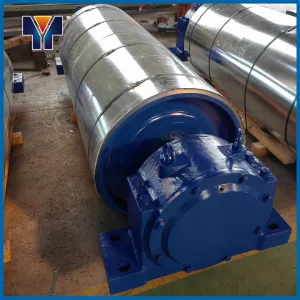
transfer roller
Category: RollerBrowse number: 2Number:Release time: 2025-09-19 10:18:39The drum is a core cylindrical component in equipment such as conveyors, printing, and mining, usually made of metal (such as carbon steel, stainless steel) or non-metallic materials, and achieves material conveying, guiding, or power transmission functions through rotational motion.From a structural perspective, a drum is generally composed of a cylinder body, shaft, bearings, seals, and other parts. Some drums are also equipped with sprockets, gears, or drum rubber surfaces to improve transmission efficiency or increase friction.Classified by function (taking the conveyor field as an example...
News
Category:
-
[Roller Group]Drive roller and idler matching system
2026-01-05 10:38:51
Case
Category:
No search results found!
Video
Category:
No search results found!
Download
Category:
No search results found!
Job
Category:
No search results found!
Featured Products
-
NEWS
transfer roller
Learn more



 Phone
Phone