
 Portugues
 Pусский
axle beam
The Axle Beam: A Critical Component in Vehicle Chassis DesignAn axle beam, often referred to as a rigid or solid axle, is a fundamental structural component in a vehicle's suspension and chassis system. Its primary function is to serve as a load-bearing member that connects a pair of wheels, maintains their relative position, and facilitates the transmission of forces between the wheels and the vehicle's frame or body. Unlike independent suspension systems where each wheel can move vertically independently, an axle beam physically links the two wheels on the same axle, meaning the movement of one wheel directly affects the other.The design and construction of an axle beam are deceptively simple yet require precise engineering. Typically forged or fabricated from high-strength steel, it is a robust, one-piece or welded assembly that must withstand immense static and dynamic loads. These include the weight of the vehicle (vertical load), braking and acceleration torques (longitudinal forces), and cornering stresses (lateral forces). The beam's cross-section—often an I-beam, tubular, or U-shape—is carefully calculated to provide optimal strength-to-weight ratio and resistance to bending and torsional flex.At its core, the axle beam performs several critical roles. Firstly, it locates the wheels, ensuring they remain parallel and at the correct track width. Secondly, it supports vertical loads, carrying the weight of the vehicle and its payload. Thirdly, it reacts to driving and braking torques, transferring the power from the differential (in a live axle) or simply resisting brake-induced twist (in a dead axle). Finally, it provides a stable platform for mounting key components such as brake assemblies, wheel bearings, and suspension linkages—typically leaf springs or coil springs with locating arms.The use of axle beams is most prominent in vehicles where durability, load-carrying capacity, and simplicity are paramount. This includes heavy-duty applications like commercial trucks, buses, and agricultural machinery, as well as the rear axles of many light trucks and traditional off-road vehicles. The key advantage lies in its inherent strength and robustness; the solid connection ensures excellent axle articulation and maintains consistent wheel alignment under severe loads and on uneven terrain. It is also generally simpler, more cost-effective to manufacture, and easier to maintain than complex independent setups.However, the design comes with inherent trade-offs. The interconnected nature of the wheels means that an impact or bump encountered by one wheel is partially transmitted to the opposite wheel, which can compromise ride comfort and high-speed handling on paved roads. It also typically results in higher unsprung weight (the mass of the suspension components not supported by the springs), which can negatively affect wheel contact with the road surface.In summary, the axle beam is a testament to robust, functional engineering. It represents a classic suspension solution where ultimate strength, reliability, and load-bearing capability are prioritized. While modern passenger cars have largely moved to independent suspension for superior comfort and handling, the axle beam remains an indispensable and irreplaceable backbone in the world of heavy-duty and utility vehicles, continuing to provide the rugged foundation required for demanding tasks. Its enduring presence underscores the principle that the optimal engineering solution is always dictated by the specific application and performance requirements.
Products
Category:
Beam
-
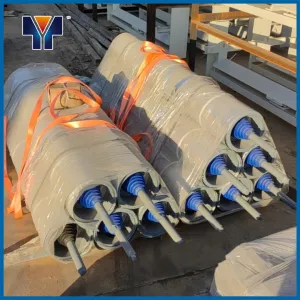
transom
Category: BeamBrowse number: 1Number:Release time: 2026-01-05 16:16:46The crossbeam of the conveyor is the core transverse support component of the conveyor frame, which is a key structural component connecting the columns (longitudinal beams) on both sides of the frame. Its main function is to fix the core components such as the roller group and the roller bearing seat, while enhancing the overall rigidity and stability of the frame, and preventing deformation or shaking of the conveyor during heavy load and high-speed operation.Core Structure and ClassificationMaterial and CraftsmanshipUsually, steel sections (channel steel, I-beams, square steel) or thick wal...
News
Category:
No search results found!
Case
Category:
No search results found!
Video
Category:
No search results found!
Download
Category:
No search results found!
Job
Category:
No search results found!
Featured Products
-
NEWS
transom
Learn more



 Phone
Phone